Master’s thesis
A Study on 1Q84’s Critical Responses
Inspecting Language and Themes of Murakami Haruki’s Novel
This thesis examines how critics and scholars have responded to Haruki Murakami’s 1Q84, with particular attention to its language, recurring themes and place within Murakami’s wider body of work.
Author
Carlo Croce
Type
Master’s thesis
University
Waseda University
Read the official abstract
Murakami Haruki is regarded among one of the already few accessible contemporary Japanese writers. According to scholar Anna Zielinska Elliot, the writer has been translated into more than 50 languages. This could be in part due to the transcultural nature of his works. Murakami’s fiction offers a wide plurality in themes of which otherness, writing and imagination are only a few. These themes in turn justify a range of linguistic constructions which embody his style, which has often been noted for its autobiographical elements and distinctnon-Japaneseness, and which scholars continue to debate. However, while discussion about the “Murakami phenomenon” (Murkami genshō) is alive and well in Japan, research on the writer based on English sources is at an earlier stage.
As noted by scholars Matthew Carl Strecher and Jess Row, any discussion related to Murakami typically commences either with the question as to whether the writer could be considered postmodern or not, or with a closer look at his use of language. Still, questions remain, both in relation to the influence Murakami’s work as a translator has had on his style and to the difficulty of translating his work abroad, as for the case of the dyslexic character Fukaeri in 1Q84.
The present research focuses on the critical answers to Murakami’s works, with a particular stress on 1Q84, known as one among the several best-sellers written by the author. The novel is divided into three volumes and has been published for the first time in 2009-10. This study aims to examine the approaches to thematic and linguistic aspects given by scholars, translators and journalists to 1Q84. Further, it argues if by confronting contributions, prerequisites, constants and analysis techniques of the critics would be possible to reach a new key of interpretation for the novel. In order to develop the research it is necessary to possess solid basis not only in global literature, but also in the methodologies for the analysis and interpretation of the text, of the processes of dialogue and comparison between cultures and of theories of language. Due to this, the research focuses on a plurality of voices and is accordingly divided into three main chapters.
The first chapter essentially analyzes characters, plot and and inspects1Q84 publishing history through the contributions of Italian and Russian translators Giorgio Amitrano and Dmitry Kovalenin. The story of the novel revolves around two main pillars: on the one hand Tengo, mathematics professor and ghost writer, works on rewriting the novelAir Chrysalis awkwardly written by the young, mysterious Fukaeri; on the other hand Aomame, normally working as a masseuse in a health club, but secretly working as a killer, begins a search for her beloved Tengo.
The second chapter inquires about genre and themes of the novel. Examining the role of writing in the story as a theme and the way it breaks normative logic, the thesis puts in evidence aqueer reinterpretation of normative conception of space and time. Thanks to the latter, a new idea of self can be negotiated, finally leading to a reflection upon Murakami’s social commitment. Building off from the nature of the novel, this chapter will further discuss the notions of otherness and responsibility of writing.
This section will particularly focus on scholar Pasha Katayun’s contribution due to its high level of adherence with the aim of the paper. Even before 1Q84’s publication, it was possible to witness the irruption of a parallel reality into several of Murakami’s novels, or as scholar Pasha defines it «simultaneous reality». (Pasha 45) This other reality, despite its unnatural features, tends to be accepted by the author’s characters as if it were ordinary. Certainly,1Q84’s characters do not miss a chance to get astonished when they happen to meet the Little People, anthropomorphic entities who scholar Jess Row believes are inspired on yūrei, ghosts that appear in Japanese folklore, or in front of a sky with two moons. However, despite these protagonists are catapulted into an irregular reality, they seem to be able to operate a surgical internalization of the new normative. Scholar Row acutely uses a comparison with homeostasis to refer to Murakami’s characters’ serene, almost passive acceptance:
[...] we might call this a state of “homeostasis” — the surgical term for a body that is self-sufficient, not in danger, and at rest.
(Row 6)
Considering what is above, it is not hard to suppose that Murakami’s characters’ encounter with otherness creates more wonder for the readers than for the characters themselves. Further, it is possible to consider this stylistic trait as belonging to the genre of magic realism, since mystery and magic are assimilated as categories of reality. In order for alterity to manifest, a break in the norms is necessary.
Along his contribution, scholar Pasha analyses how 1Q84 has been placed in the position to challenge normativity, what is preset, and binarism; in fact the scholar examines the processes according to which Aomame, Tengo, Fukaeri, or even the same narrative universe built by Murakami open a fracture in the normativity. Altering the perception of spaces, of time or through what is other, Murakami seems to offer a vital space to his own characters, enabling their redefinition. Pushing his protagonists towards liminal areas he discusses their identities, which get sectioned and exposed to a dimension where to find new possible perceptions of the self through categories independent from the normativity. In this perspective, Murakami’s work could be defined as socially committed, not necessarily in strictly political terms, since through its contents it offers an example of challenge for the search of new measures of the self.
The third chapter, remarking the peculiarmukokuseki style of the author, studies the perception of Murakami’s identity analyzing the reception of his language across several countries. Discussing the dispute related to his style in Brazil or USA, where readers were first looking in his novels for presumed canons of Japanese literature, the present thesis inspects the problems of his translations abroad tied to: the author’s characteristic intertextuality, which urged translators to start a research broadening the novel itself; the abridgements of his works abroad, accused to alter the text’s original meaning; the dyslexia of the protagonist Fukaeri, whose disease was visible in the novel through peculiar techniques, such as the omission of kanji and punctuation, which asked translators to move towards a new exploration of their culture, and come up with original solutions according to their specific languages.
Building off from the questions “How has Murakami been perceived on an international level? Did his perception change through time?” the present thesis opens a discussion around potential connections on this matter. Through the years scholars, journalists, and translators have in fact offered several points of view to reflect on how Murakami’s identity abroad kept changing.
Furthermore, translator Lica Hashimoto gave her contribution to the discussion as well, offering insights about her translation into Portuguese of 1Q84, and how Brazilian market and readers reacted to the publication of the latter. Hashimoto explains how Japanese literature in Brazil has been influenced by the American editors’ canon for several years. Back then, Japan was regarded as “source of sexiness, nostalgia, and a world “upside-down””. (Hashimoto 179) and Brazilian readers were looking for those elements they considered distinctive traits of Japanese narrative, such as ambiguity, sensuality, lust, or interiority, of which Kawabata Yasunari, and Mishima Yukio, translated from French or English, have been considered amongst the main representative figures. Yet, those same readers were not able to identify those typical traits in Murakami’s stories. (Hashimoto 179) Anna Zielinska-Elliot describes a similar process in America:
[...] when Murakami’s books made their Western debut in the United States and Great Britain, some critics were surprised to find them so “American” or “Western” in tone. Prevailing assumptions about the canonical elements obligatory for a Japanese novel led many to comment on what they thought should by rights have been there but was not.
(Zielinska-Elliott 98)
During the years between 1980 and the publication of 1Q84, many of those orientalisms had already been abandoned. (Hashimoto 180) Zielinska offers an example of how both European and American readers, accompanied by the international success of Murakami, could rewrite their perception of the writer, which from “Japanese author” became an author whose nationality is only an aspect among others. In conclusion, Hashimoto confirms how the “Murakami phenomenon” allowed an overall reorganization of the perception of geographical boundaries, leading the readers’ eyes towards an essentially universal perspective.
Questions remain, however, concerning the future stances of the works of the author, as well as the possibilities to find new ways of interpretation for the already published ones. The presence of such unanswered contents could lead to the future steps in the study, giving an appreciable direction to follow for additional contributions to the research on this topic.
Read the full thesis
The embedded reader may not work on every browser or mobile device. Open the PDF directly.
Behind the work
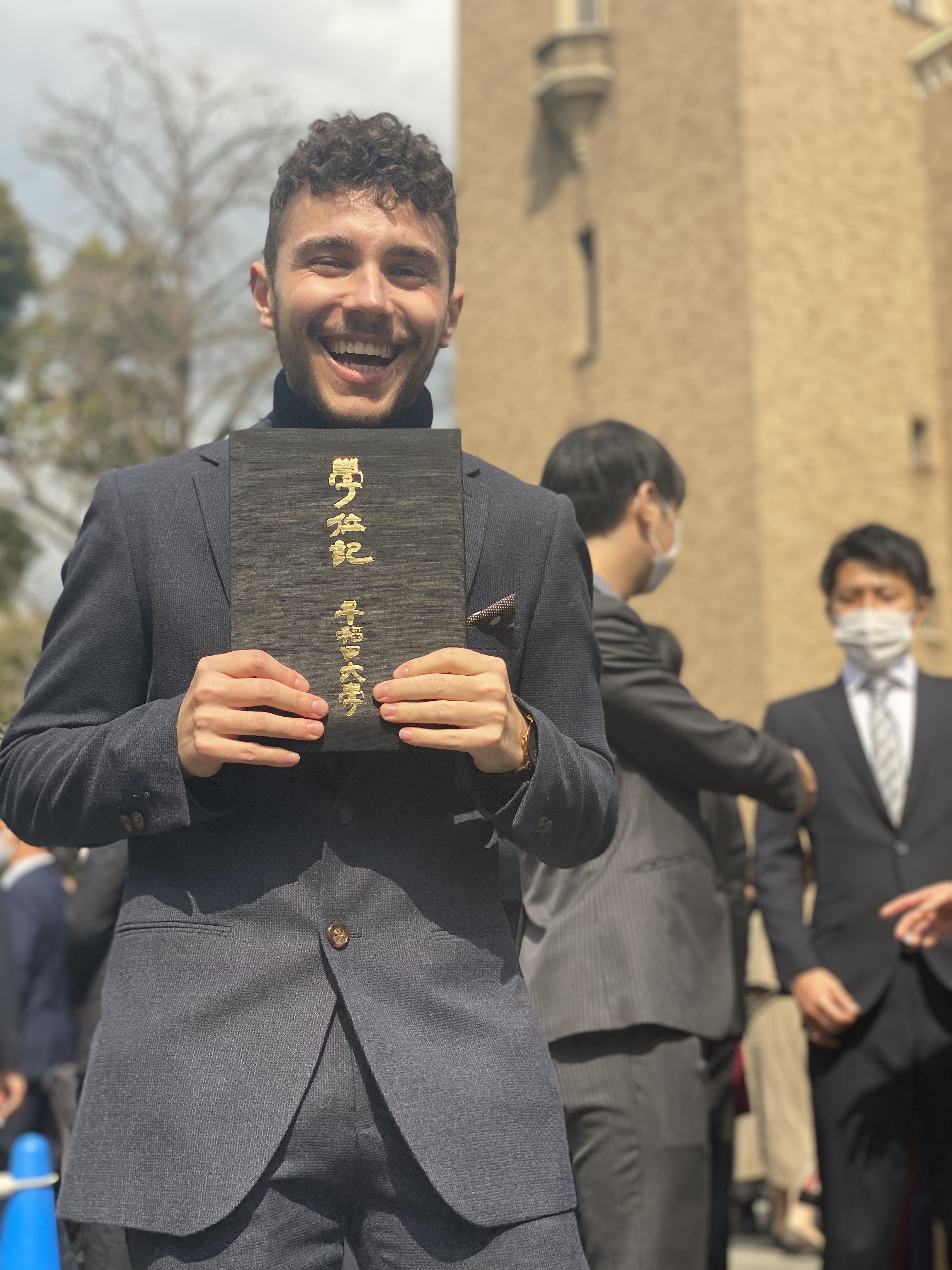
Graduation ceremony
Holding the certificate that represents the culmination of my master’s degree and the work I invested in this thesis. Without it, I would not have graduated from Waseda University, the same university Haruki Murakami attended.
Analogue photograph by my then-colleague Nanaka Kan.